
Inception released Mercury 3 on Monday, and you can pick it from the model menu in Chat today.
Mercury is an unusual kind of language model. Most models write an answer one word after another, left to right. Mercury is a diffusion model: it starts from a rough draft of the whole answer and refines it over a few passes, so it can work on many parts at once. That is where the speed comes from. Inception measured 1,068 tokens per second on NVIDIA GPUs.
Inception@_inception_aiMercury 3 is live: the most capable diffusion LLM released to date. It outperforms GPT-6 Luna and Claude Haiku 5.5 across a range of benchmarks while running at over 1,000 tokens per second. More than 40x the size of Mercury 1, 3x more intelligent across standard benchmarks, and…
Oct 19, 2026 · View on X
What changed in Mercury 3
According to Inception, Mercury 3 has more than 40 times the parameters of the first Mercury and scores about three times higher on standard benchmarks, at the same speed. Its context window grows to 1 million tokens, up from 260,000 in Mercury 2.5. The company says it beats GPT-6 Luna and Claude Haiku 5.5 on a range of benchmarks while running four to eight times faster.
Those are Inception's own numbers and have not been independently repeated. Treat them as a good reason to try the model, not as a verdict.
Where a model like this fits
Speed matters most when waiting is the cost: a quick edit, a classification, a follow-up question, a draft you are going to rewrite anyway. For slow, multi-step work you will probably still want a larger model.
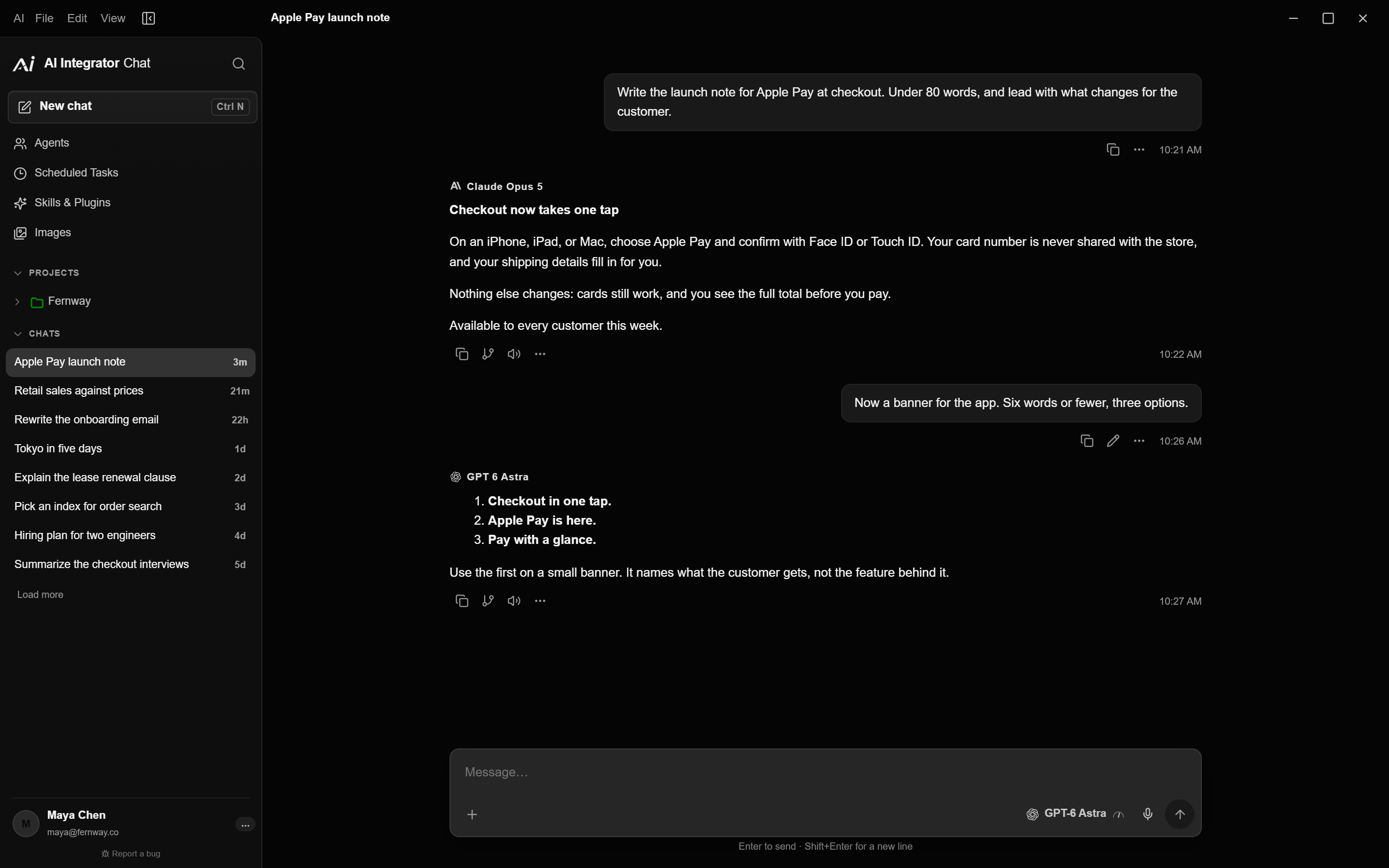
You do not have to pick one for the whole conversation. In Chat the model is a choice you make for each message, so you can ask Mercury for a fast first pass and send the next message to another model. That model reads everything said so far.
Mercury 3 launched at $0.20 per million input tokens and $0.70 per million output tokens, with half off during the launch period.